
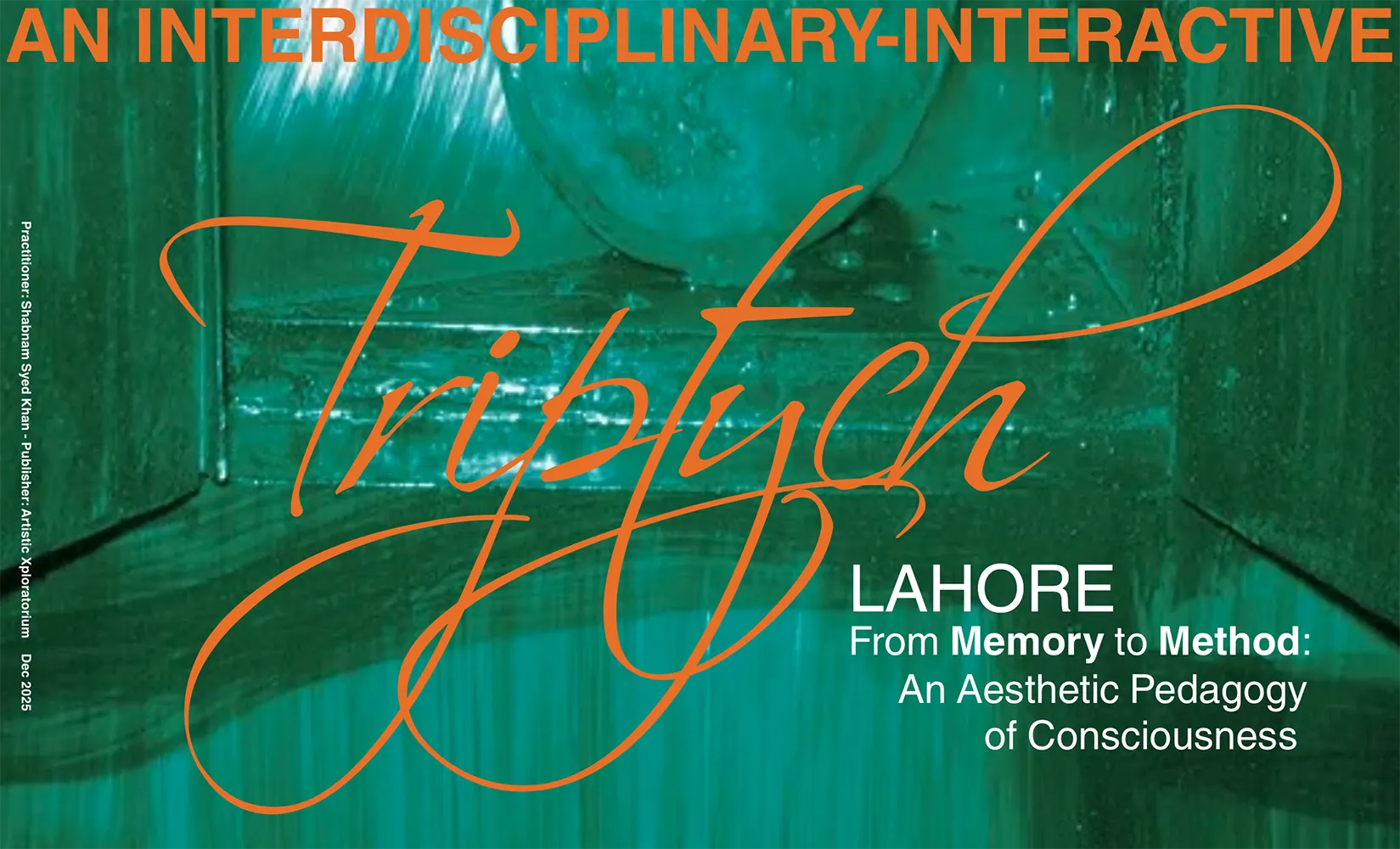
The storied city of Lahore, in Yashpal’s 1947 Partition of the Indian Subcontinent novel, “Jhootha –Sach,” from which I have drawn inspiration for the interdisciplinary Lahore Triptych, entitled “Lahore, From Memory to Method: An Aesthetic Pedagogy of Consciousness” exists in many layers: in the streets we walk today, in the memories carried by those who left in the wake of the 1947 Partition, and in the pages of literature where it remains suspended in time:
“…fragmented cosmologies of the city reveal how memory, capital, and survival speak over and through each other…”
(https://www.stirworld.com/stirfri-vol-10-issue-10)
“Lahore, From Memory to Method: An Aesthetic Pedagogy of Consciousness,” or Lahore Triptych brings together history, nostalgia, hope, good will and artistry to explore Lahore’s intrinsic cultural historicity of communal interconnectedness and the 1947 wounded legacy as a conceptual unit of analysis to imagine a purposeful Partition pedagogy, which seeks to ask: How the Partition of 1947 ought to be taught in Indian and Pakistani schools that Indians and Pakistanis see each other as one of their own?
This question is important. The Partition curricula in Indian and Pakistani educational institutions, by design, have planted mutual suspicions among the post-Partition generations in both countries. Putting the peaceful co-existence of 1.7 billion people at permanent risk.
Lahore Triptych is one of the vignettes of the speculative model of pedagogy–the Consciousness Curriculum (CC)— I have been theorizing and practicing since 2010 in tandem with an experimental qualitative research methodology, “I-Thou Theory.” Aesthetically conceived and purposefully structured, the learning and teaching methodology inherent in Lahore Triptych is aimed at deliberately obliterating endemic hostilities. Sowing self-transforming minds that know their limitations, look for interconnectedness, and honor the point of view of an opponent, the CC frames higher-order consciousness as the objective of education for the VUCA 21st century. The CC is grounded in the relational frameworks and dialogic philosophies of Rumi, Martin Buber, and Daniel Kahneman. For both conceptual inspiration and practical application, Robert Kegan’s theory of Adult Development, and the tested Kegan-Lahey counselling mechanism Immunity-to-Change (ITC) are endlessly referenced and artfully appropriated.
Lahore Triptych brings together three interlinked explorations: Triptych-1. “Celebrating Lahore: Reading Jhootha Sach in Lahore.” Triptych-2. “Yashpal’s Lahore and Mine.” and Triptych-3. “I-Thou: The New Pedagogy of Partition Studies.” Together, they form an evolving artistic and literary inquiry into the city of Lahore, the trauma of Partition, and the enduring possibilities of developing the capacity for shared humanity through the invocation of a deliberately developmental curriculum. Enabling Indians and Pakistanis to perceive 1947 Partition not as a curse, not a punishment, but a historical episode where contesting facts jostle to be believed in the chorus of neighborly spirit, and feel fine knowing that:
“We are already scattered, already plural, already speaking in many tongues. What matters is whether differences become ground for solidarity, or fissure for confusion and control. For all oppression is connected, all liberation, collective. If Babel scatters us, it also shows: no one story can ever hold or heal the world.”
(https://www.stirworld.com/stirfri-vol-10-issue-10)
Practitioner
Shabnam Syed Khan
Collaborators
Dr. Iram Zia Raja
Triptych 3: I-Thou: The New Pedagogy of 1947 Partition Studies
Shahvaar Ali Khan
Triptych 1: Celebrating Lahore: Reading Jhootha-Sach in Lahore
Song: Mussalman Koan Hai…
Poetry: Syed Ikram Hussain, Ishrat & Zahira Hussain
Lyrics & Songwriting: Shahvaar & Shumair
Sung and Composed by Shahvaar Ali Khan
Triptych 3: I-Thou: The New Pedagogy of 1947 Partition Studies
Song: Azad Ki Dua…
Poetry: Jagan Nath Azad
Sung and Composed by Shahvaar Ali Khan
Book Layout & Design: AX (Artistic Xploratorium)
Publisher: AX (Artistic Xploratorium)
ISBN: 978-1-0695957-1-3
Copyright © 2025 Shabnam Syed Khan
The storied city of Lahore, in Yashpal’s 1947 Partition of the Indian Subcontinent novel, “Jhootha –Sach,” from which I have drawn inspiration for the interdisciplinary Lahore Triptych, entitled “Lahore, From Memory to Method: An Aesthetic Pedagogy of Consciousness” exists in many layers: in the streets we walk today, in the memories carried by those who left in the wake of the 1947 Partition, and in the pages of literature where it remains suspended in time:
“…fragmented cosmologies of the city reveal how memory, capital, and survival speak over and through each other…”
(https://www.stirworld.com/stirfri-vol-10-issue-10)
“Lahore, From Memory to Method: An Aesthetic Pedagogy of Consciousness,” or Lahore Triptych brings together history, nostalgia, hope, good will and artistry to explore Lahore’s intrinsic cultural historicity of communal interconnectedness and the 1947 wounded legacy as a conceptual unit of analysis to imagine a purposeful Partition pedagogy, which seeks to ask: How the Partition of 1947 ought to be taught in Indian and Pakistani schools that Indians and Pakistanis see each other as one of their own?
This question is important. The Partition curricula in Indian and Pakistani educational institutions, by design, have planted mutual suspicions among the post-Partition generations in both countries. Putting the peaceful co-existence of 1.7 billion people at permanent risk.
Lahore Triptych is one of the vignettes of the speculative model of pedagogy–the Consciousness Curriculum (CC)— I have been theorizing and practicing since 2010 in tandem with an experimental qualitative research methodology, “I-Thou Theory.” Aesthetically conceived and purposefully structured, the learning and teaching methodology inherent in Lahore Triptych is aimed at deliberately obliterating endemic hostilities. Sowing self-transforming minds that know their limitations, look for interconnectedness, and honor the point of view of an opponent, the CC frames higher-order consciousness as the objective of education for the VUCA 21st century. The CC is grounded in the relational frameworks and dialogic philosophies of Rumi, Martin Buber, and Daniel Kahneman. For both conceptual inspiration and practical application, Robert Kegan’s theory of Adult Development, and the tested Kegan-Lahey counselling mechanism Immunity-to-Change (ITC) are endlessly referenced and artfully appropriated.
Lahore Triptych brings together three interlinked explorations: Triptych-1. “Celebrating Lahore: Reading Jhootha Sach in Lahore.” Triptych-2. “Yashpal’s Lahore and Mine.” and Triptych-3. “I-Thou: The New Pedagogy of Partition Studies.” Together, they form an evolving artistic and literary inquiry into the city of Lahore, the trauma of Partition, and the enduring possibilities of developing the capacity for shared humanity through the invocation of a deliberately developmental curriculum. Enabling Indians and Pakistanis to perceive 1947 Partition not as a curse, not a punishment, but a historical episode where contesting facts jostle to be believed in the chorus of neighborly spirit, and feel fine knowing that:
“We are already scattered, already plural, already speaking in many tongues. What matters is whether differences become ground for solidarity, or fissure for confusion and control. For all oppression is connected, all liberation, collective. If Babel scatters us, it also shows: no one story can ever hold or heal the world.”
(https://www.stirworld.com/stirfri-vol-10-issue-10)
Practitioner
Shabnam Syed Khan
Collaborators
Dr. Iram Zia Raja
Triptych 3: I-Thou: The New Pedagogy of 1947 Partition Studies
Shahvaar Ali Khan
Triptych 1: Celebrating Lahore: Reading Jhootha-Sach in Lahore
Song: Mussalman Koan Hai…
Poetry: Syed Ikram Hussain, Ishrat & Zahira Hussain
Lyrics & Songwriting: Shahvaar & Shumair
Sung and Composed by Shahvaar Ali Khan
Triptych 3: I-Thou: The New Pedagogy of 1947 Partition Studies
Song: Azad Ki Dua…
Poetry: Jagan Nath Azad
Sung and Composed by Shahvaar Ali Khan
Book Layout & Design: AX (Artistic Xploratorium)
Publisher: AX (Artistic Xploratorium)
ISBN: 978-1-0695957-1-3
Copyright © 2025 Shabnam Syed Khan